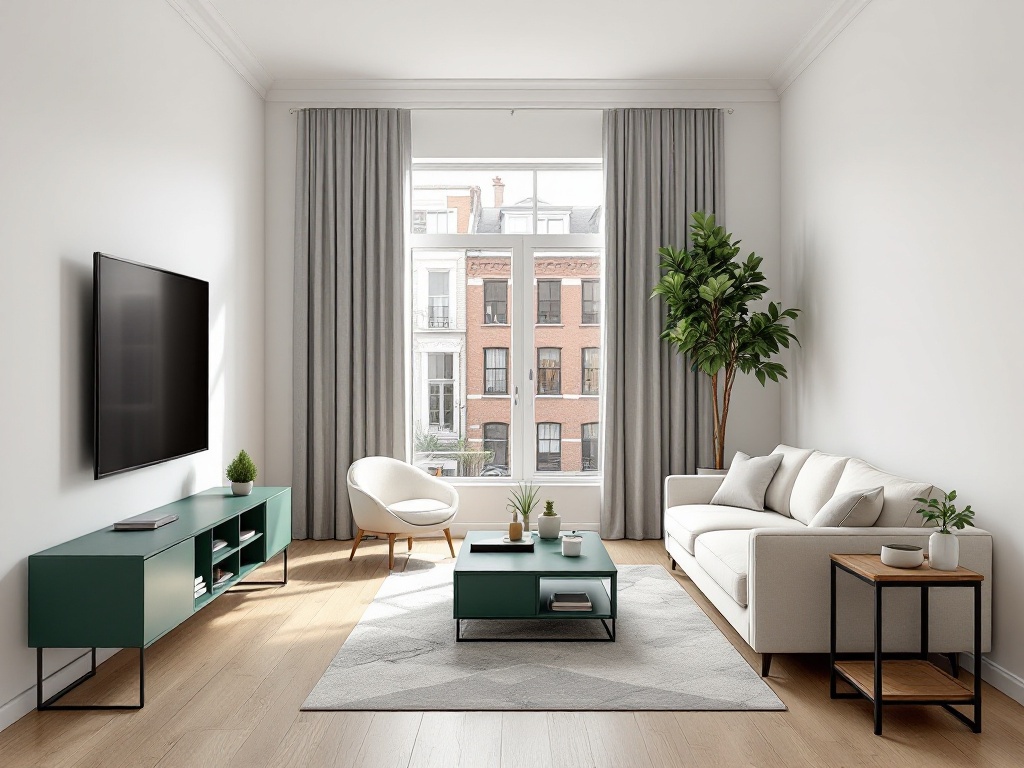
A hotel room in central London is, on average, a box of roughly 15 square metres with a bed, a kettle and a window you cannot open. That is not a criticism. It is a product, and for two nights in transit it is often the right one. The question worth asking is a narrower one: when does it stop being the right one?
The honest answer is that it depends on three things — how long you are staying, how many of you there are, and whether you intend to spend any waking hours in the room at all. Everything else is noise.
The comparison
What actually differs
Most comparisons of this kind are written to reach a predetermined conclusion. This one is not. Here is the shape of the trade, set out plainly.
| Hotel | Serviced apartment | |
|---|---|---|
| Space | One room, shared by everyone in it | Separate living, sleeping and dining areas |
| Priced by | The room — a second room doubles the cost | The apartment — party size does not change the rate |
| Eating | Every meal bought out or from room service | Full kitchen; eat out when you choose to, not because you must |
| Laundry | Charged per item | Washer-dryer in the apartment |
| Housekeeping | Daily, whether wanted or not | Scheduled to the stay; the space stays yours between visits |
| Location | Clustered where hotels are zoned | Residential streets, on the terms of people who live there |
| Best for | One or two nights, alone, out all day | Four nights or more, or two people and up |
In fairness
When the hotel is the better choice
We are not going to pretend otherwise. If you land at six, take a meeting at nine and fly out the following evening, a hotel will serve you better than we will. You want a desk in reception at any hour, a bag stored after checkout, and breakfast without a decision attached. That is what hotels are engineered for, and they are very good at it.
The same applies if you genuinely want the room tidied every morning by someone you never meet, or if a loyalty programme is doing real work for you. None of that is served by an apartment, and it would be dishonest to claim it is.
The question is not which is better. It is which is better for the stay you are actually taking.
The case for the apartment
Where the maths turns
Around the fourth night
Somewhere around the third or fourth night, a hotel room stops feeling compact and starts feeling small. The suitcase has nowhere to live. There is no table to eat at, so you eat on the bed. Two people in one room means one of you goes to sleep when the other does. An apartment removes all three problems at once, and it does so without a single line item.
When there is more than one of you
This is where the comparison stops being close. Four people in a hotel is two rooms — two rates, two bathrooms, and no shared space that is not a lobby or a bar. Four people in a two-bedroom apartment is one rate and a living room. The nightly figure may look higher on the search page. Run it per person and it rarely is.
When you are staying long enough to need a life
Relocations, extended projects, a renovation at home, a season in the city. Past a fortnight, the things a hotel cannot give you become the only things that matter: a washing machine, a fridge with your own food in it, a door that opens onto a street where people are walking their dogs rather than wheeling luggage.

Where we are
The address is the amenity
Hotels sit where hotels are permitted to sit, which is why so much of a London hotel stay happens on the same handful of arterial roads. Apartments sit on residential streets, because that is what they are. The difference is not romantic — it is the reason your morning starts at a bakery rather than a buffet.
Our apartments are in the parts of central London people live in rather than pass through:
- Marylebone — a village that happens to be ten minutes from Oxford Street, and behaves like one.
- Fitzrovia — Charlotte Street's restaurants at one end, the quiet of Bloomsbury at the other.
- Bayswater — Hyde Park at the end of the road, and the best-value walk into the centre in London.
- Kensington — garden squares, the museums within reach on foot, and almost no through traffic.
Deciding
Three questions, and you have your answer
Forget the category. Answer these:
- How many nights? One to three, take the hotel. Four or more, the apartment starts winning and does not stop.
- How many people? Anything above one, and you are comparing one apartment rate against two hotel rates. Do that sum before you book.
- Will you be in the room? If it is only for sleeping, its size does not matter. If it is a base — mornings, evenings, a day off — it is the whole stay.
If those answers point to a hotel, take the hotel. If they point the other way, that is what we do — apartments run to hotel standards, in the neighbourhoods hotels cannot reach, with someone reachable at any hour for the length of your stay.
VI&CO manages a curated portfolio of short and mid-term apartments across London, Paris, Lake Como and Dubai. See the collection.